kids park rides

kids park rides

2015年8月31日星期一

History of Kiddie Rides

The kiddie ride was invented in 1930 by James Otto Hahs of Sikeston, Missouri. Originally called the Hahs Gaited Mechanical Horse, the coin operated kiddie rides was originally conceived as a Christmas present for his children. However, Hahs soon realized that he has a potential money-maker in his hands and set about commercializing the toy. Initially, he used wooden horses not unlike those found on carousels, and commissioned carousel makers to make the horses. However, he soon found these horses to be heavy, and decided that aluminum would be a better material to sculpt his horses out of. When told it can't be done, however, Hahs went ahead and invented a process to form horses out of aluminum. These amusement kiddie rides would be manufactured at Hahs Machine Works in Sikeston, Missouri and went on to win several awards, including most original invention of the year 1932. In 1933, Hahs struck a deal with Exhibit Supply Company to distribute his horses, with a 5% cut going to Hahs. When the patent on the ride eventually ran out, Hahs had retired as a wealthy inventor. In 1953, Billboard magazine called it "1953's fastest growing business". Eventually, the rides changed from aluminum to fiberglass.
kiddie rides for sale
Hot Fun Park Rides Manufacture Co., Ltd was established in 2001, is a professional engaged in R & D, production, amusement equipment sales and installation as one of the modern enterprise, is CAAPA, RAAPA, IAAPA, DEAL member unit. Specializing in the production of horse, pirate ship, flying chair, small train mechanical amusement equipment. Have a professional R & D and the international, domestic sales team. Products are exported to Japan, Europe, Southeast Asia, America, Middle East, South Africa, on 4 continents, more than 30 countries and regions each.

2015年8月30日星期日

Kiddie ride - coin operated kiddie rides

A kiddie ride - or kids' ride - is a coin-operated amusement ride for small children. Kiddie rides are commonly available in amusement parks, arcades, malls, hotel game rooms and outside supermarkets and discount department stores. Less commonly, they may also appear in other venues such as restaurants, food courts, grocery shops and auto dealerships. When activated by a coin, a kiddie ride entertains the rider with motion, depending on the ride type (miniature Ferris wheel, miniature carousel, miniature train ride or stationary platform ride). Most rides include sounds and music, and some feature flashing lights, pedals, and buttons. Commercial kiddie rides often use simple but colorful equipment, with the driving mechanism usually hidden under vacuum formed plastic covers.
Hot Fun Park Rides Manufacture Co., Ltd was established in 2001, is a professional engaged in R & D, production, amusement equipment sales and installation as one of the modern enterprise, is CAAPA, RAAPA, IAAPA, DEAL member unit. Specializing in the production of horse, pirate ship, flying chair, small train mechanical amusement equipment. Have a professional R & D and the international, domestic sales team. Products are exported to Japan, Europe, Southeast Asia, America, Middle East, South Africa, on 4 continents, more than 30 countries and regions each.

2015年8月27日星期四

carousel horse ride

Carousels are commonly populated with horses, called carousel horse ride, each horse weighing roughly 100 lbs. (45 kg), but may include diverse varieties of mounts, like pigs, zebras, tigers, or mythological creatures such as dragons or unicorns. Sometimes, chair like or bench like seats are used as well, and occasionally mounts can be shaped like airplanes or cars. As was the case with most industries during the Great Depression, carousel builders found it difficult to continue production. In addition to the depressed economy, the rise of the roller coaster in the early 20th century began to overshadow the carousel’s place in the amusement park industry. They became marked as a “children’s ride” because they lacked the excitement of the newer rides. This combination of factors spelled the end of an era for carousel builders. Although more would be built once the economy recovered, they were no longer hand-carved, but instead cast in aluminum and fiberglass. However, since the 1970s, there has been a growing interest in restoring many of the old hand-carved carousels and preserving them for future generations.
carousel kiddie ride

2015年8月24日星期一

The overall introduction of carousel ride

A carousel, roundabout or merry-go-round, is an amusement ride consisting of a rotating circular platform with seats for riders. The "seats" are traditionally in the form of rows of wooden horses or other animals mounted on posts, many of which are moved up and down by gear work to simulate galloping, to the accompaniment of looped circus music.[citation needed] This leads to one of the alternative names in AmEng, the galloper. Other popular names are jumper, horse about and flying horses.
Carousel rides may not be able to compete with many of today’s technically advanced rides, yet they are still beloved by amusement park visitors of all ages. They also play an important role in the evolution of amusement parks. As one of the earliest rides to appear at the fairs and amusement areas that were the blueprints for today’s amusement parks, they helped whet the public’s appetite for bigger and better amusement park rides. In a playground, a roundabout or merry-go-round is usually a simple, child-powered rotating platform with bars or handles to which children can cling while riding.

carousel for sale

Thrill ride or kid’s ride?
Carousel amusement ride are not considered "thrill machines" by any stretch of the imagination. Still, carousels are as reliant on the laws of motion as their more exciting cousins, the roller coasters. It's theoretically possible that, allowed to spin out of control, a carousel could gain enough speed so that the riders would be thrown off. Thankfully, runaway carousels are not the least bit common. With all of its beauty and seeming simplicity, the carousel is a delicate balance of motion and forces. All of the horses move through one complete circle in the same amount of time. The horses on the outside of the carousel have to cover more distance than the inside horses in the same amount of time. This means the horses on the outside have a faster linear speed than those at the hub. On some carousels, the horses go up and down in a galloping motion simulating what it might be like to ride a real horse.

2015年8月23日星期日

For sale: Arab Flying Carpet, Amusement Carpet Rides for sale

Arabic flying carpet is a large amusement equipment/device for tourist doing variable speed reverberated movement in the air. Riding on flying carpet is full of travelling in space, when the flying carpet up to the highest point accompanying with swing left and right, as if flying to space.That The blanket is sometimes high and sometimes low, liking severe overweight or losing weight, make the tourist feel deeply thrilling and exciting. Amusement carpet rides rotates riders vertically but keeps them heads-up is called. Be applicable to park and other amusement places, deeply loved by the modern teenager.

Hot Fun Park Rides Manufacture Co., Ltd was established in 2001, is a professional engaged in R & D, production, amusement equipment sales and installation as one of the modern enterprise, is CAAPA, RAAPA, IAAPA, DEAL member unit. Specializing in the production of horse, pirate ship, flying chair, small train mechanical amusement equipment. Have a professional R & D and the international, domestic sales team. Products are exported to Japan, Europe, Southeast Asia, America, Middle East, South Africa, on 4 continents, more than 30 countries and regions each.

2015年8月21日星期五

Different Types of Octopus

There are different kinds of Octopus. They are:
  • Eyerly Monster—This ride has six arms, and has four cars attached right above the arm. The cars also spin independently and they have to loaded separately by an employee.
  • Eyerly Octopus—This kind of octopus ride has eight arms, and has the two cars attached right above the arm. The cars spin independently and each car must be loaded separately by an employee.
  • Eyerly Spider—You will notice that this carnival rides runs exactly like the Octopus. The difference is that the arms are more curved down. It has six arms (rather than eight), and has the two cars attached right above the arm. The cars spin independently and the cars must be loaded separately by an employee.
  • Schwarzkopf Monster II—The amusement rides has five arms, and has five cars attached each to arm. However, this ride is different from the previous three. Each arm has metal bars attached to the center of the arm. The center moves in a circle. The cars attach to the metal bars. There are also five arms. The cars do spin independently, and they don't have to be loaded separately by an employee. Sartori also has a ride just like this called a Polyp.
  • SDC Polyp—This ride is just like the Schwarzkopf Monster II, but the difference is that the cars don't move independently. They are just stuck on the arms moving. You can see from the picture that the cars are built into the side of the arm.
  • Airwave has a spinning metal bar that holds 4 small jets as were the riders sit down however the big arms can swing but not go upside down during the ride spins.

2015年8月19日星期三

The History of Roller Coaster

Russian mountain

The oldest roller coasters are believed to have originated from the so-called "Russian Mountains", which were specially constructed hills of ice, located especially around Saint Petersburg. Built in the 17th century, the slides were built to a height of between 21 and 24 m (70 and 80 feet), consisted of a 50 degree drop, and were reinforced by wooden supports.

Some historians say the first roller coaster - thrill rides was built under the orders of Russia's Catherine the Great in the Gardens of Oranienbaum in Saint Petersburg in the year 1784. Other historians believe that the first modern roller coaster was built by the French. The Promenades Aeriennes in Parc Baujon and the Les Montagnes Russes à Belleville (The Russian Mountains of Belleville) were both constructed in Paris in 1817 and both featured wheeled cars securely locked to the track, guide rails to keep them on course, and higher speeds.

The name Russian Mountains to designate a roller coaster ride is preserved in most Latin languages. However, the Russian term for roller coasters is "американские горки" ("amerikanskiye gorki"), which means "American Mountains".

Scenic gravity railroads

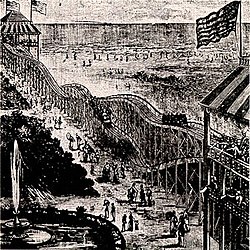
Thompson's Switchback Railway, 1884.
In 1827, a mining company in Summit Hill, Pennsylvania constructed the Mauch Chunk gravity railroad, an 8.7-mile (14.0 km) downhill track used to deliver coal to Mauch Chunk (now known as Jim Thorpe), Pennsylvania. By the 1850s, the "Gravity Road" (as it became known) was providing rides to thrill-seekers for 50 cents a ride. Railway companies used similar tracks to provide amusement on days when ridership was low.

Using this idea as a basis, LaMarcus Adna Thompson began work on a gravity Switchback Railway that opened at Coney Island in Brooklyn, New York in 1884. Passengers climbed to the top of a platform and rode a bench-like car down the 600-foot (180 m) track up to the top of another tower where the vehicle was switched to a return track and the passengers took the return trip.This track design was soon replaced with an oval complete circuit. In 1885, Phillip Hinkle introduced the first full-circuit coaster with a lift hill, the Gravity Pleasure Road, which was soon the most popular attraction at Coney Island. Not to be outdone, in 1886 LaMarcus Adna Thompson patented his design of roller coaster that included dark tunnels with painted scenery. "Scenic Railways" were to be found in amusement parks across the county, with Frederick Ingersoll's construction company building many of them in the first two decades of the 20th century.
Popularity, decline and revival

By 1919, the first underfriction roller coaster funfair rides had been developed by John Miller. Soon, roller coasters spread to amusement parks all around the world. Perhaps the best known historical roller coaster, The Cyclone, was opened at Coney Island in 1927.

The Great Depression marked the end of the first golden age of roller coasters, and amusement parks in general went into decline. This lasted until 1972, when The Racer was built at Kings Island in Mason, Ohio (near Cincinnati). Designed by John Allen, the instant success of The Racer began a second golden age, which has continued to this day.


Steel roller coasters

In 1959 Disneyland introduced a new design breakthrough with Matterhorn Bobsleds. This was the first roller coaster to use a tubular steel track. Unlike wooden coaster rails, which are generally formed using steel strips mounted on laminated wood, tubular steel can be easily bent in any direction, which allows designers to incorporate loops, corkscrews, and many other maneuvers into their designs. Most modern roller coasters are made of steel, although wooden coasters are still being built.